Hiển thị các bài đăng có nhãn Photographers: Travel. Hiển thị tất cả bài đăng

Thứ Bảy, 28 tháng 5, 2011

Fred Canonge: Pehlwan of Benares

Photo © Fred Canonge-All Rights Reserved
Pehlwani (also known as Kushti) is a traditional style of wrestling popular in the sub-continent of India, Pakistan and Bangladesh. The wrestler is known as pahlawan which, interestingly for those who are etymologists, is the colloquial Arabic word meaning "clown". I wouldn't tell this to these wrestlers, as they would be offended and I'd be on the mat in less than a second.

Based in Paris, Fred Canonge is a French freelance photographer who has extensively travelled in India for the last ten years, and is constantly exploring all the nuances and the diversity of Indian society. His website is replete with galleries of India, including some of images made in Kathputli and Varanasi, but the gallery which I liked the most has his work on the pehlawan.

Varanasi has a number of traditional wrestling training gyms (known as akhara), and one can spot them working with rudimentary weights near Tulsi ghat. The wrestlers' diets consist of milk, almonds, ghee, eggs and chapattis, but have a difficult time making ends meet. Some of them find work as bodyguards to those who need protection or as "enforcers" during political elections.

Mitchell Kanashkevich: Vanuatu (And More)

Photo © Mitchell Kanashkevich - All Rights Reserved
As promised, here's the updated website of Mitchell Kanashkevich, replete with new inspirational imagery of his recent travels. One of the best travel, documentary and cultural photographers I know, Mitchell describes himself as a tireless wanderer and documentarian. He's also an author, and published several popular ebooks. You'll also agree with me that Mitchell's photographs are gorgeous, and the new website is equally lovely. It's for a good reason that his website is on my blogroll.


On his website, he introduces us to various galleries of his travels in Vanuatu. The first gallery is of South West Bay, a remote enclave on the island of Malekula. It is separated from the rest of the island by mountains and dense forest, and the only way to get there is by sea or air. Until 50 years ago, its tribal inhabitants practiced cannibalism and warfare. Although the introduction of Christianity resulted in the disappearance of these practices, it also caused the erosion of traditional rituals and customs.

Vanuatu is an island nation located in the south Pacific ocean, and includes more than 80 islands, out of which 65 are inhabited. Its population is less than 220,000 and are of Melanesian descent. I came across Vanuatu while involved in the banking industry, as it's an offshore financial center and a tax haven...but I never imagined that it would have such visual beauty.

Thứ Sáu, 27 tháng 5, 2011

Jacob Maentz: The Infanta Penitents


Photo © Jacob Maentz-All Rights Reserved

I've been terribly remiss in covering the Philippines on this blog, but Jacob Maentz's fine work on this Asian nation will go a long way to rectify this.

Originally from the United States, Jacob is based in the Philippines from where he does considerable amounts of travel, working on freelance assignments and shooting stock photography. His travels to Latin America whilst in college is where he discovered his passion for the camera. He was brought to the Philippines in 2003 when he joined the United States Peace Corps and has found himself repeatedly drawn back to this part of the world since then.

Most of his galleries are of the Philippines, and I chose to feature the very interesting Infanta Penitents here.

Jacob writes that "Self flagellation practices were adopted by Filipinos during their Spanish colonization almost 500 years ago. Flagellants are practitioners of an extreme form of mortification of their own flesh by whipping it with various instruments. Today, you can still see some Christians practicing flagellation in the Philippines as a form of devout worship and personal sacrifice, sometimes in addition to self-crucifixion. In the Philippine province of Quezon there are still a number of men who wear elaborate costumes while preforming their act of self flagellation."

When you've looked the Infanta Penitents, continue exploring Jacob's galleries. I did, and learned much about the cultural wealth of the Philippines.

Paul Levrier: Visions of Indochina

Photo © Paul Levrier -All Rights Reserved
 Paul Levrier is in a good position to photograph all over South East Asia and in particular in Indochina. He's the managing director of a travel company specializing in Vietnam (where he's been based for the past 14 years) and Cambodia.

He's also the founder of Visions of Indochina which is a digital image bank/library. Whilst one needs to register to gain full access to the library, there's enough there to satisfy all Vietnamophiles (is that the right term?) with lovely images of its various festivals, as well as a section for multimedia.

Since the site is principally an image bank, its navigation seems a little quirky but you'll get the hang of it and you'll find lovely photographs of Vietnam, as well as Laos and Cambodia.

Thứ Tư, 25 tháng 5, 2011

The Hijras (Eunuchs) of Becharaji


Photo © Tewfic El-Sawy-All Rights Reserved

Eunuchs, transsexuals, or transgender men are known as hijras in South Asia. They adopt feminine gender identity, women's clothing and other feminine gender roles. Etymologically, the word hijra is an Urdu word, seemingly derived from the Arabic root hijr or emigration in the sense of "leaving one's family, tribe or country," and it has been borrowed into Hindi.


Photo © Tewfic El-Sawy-All Rights Reserved

Many hijra live in all-male communities, and have sustained themselves over generations by "adopting" young boys who are rejected by, or flee their family. Many work as male sex workers for survival. According to estimates by health organizations, only 10% of hijras are actually castrated.


Photo © Tewfic El-Sawy-All Rights Reserved

During my Tribes of South Rajasthan & Kutch Photo~Expedition™ , we stayed at the immaculate and well-run Rann Riders resort in Dasada, and its knowledgeable owner Muzahid Malik, suggested we visited Becharaji where hijras frequented its temple.


Photo © Tewfic El-Sawy-All Rights Reserved

As I walked in to the temple ahead of my group, I chanced upon hijras who, upon seeing me, started to clap their hands and laughing. Not really catching on that this was their trademark way of announcing their presence and sexual persuasion, I imitated them and clapped in exactly the same way...one hand on the top of the other, rather than sideways. This drove them to raucous laughter, and eventually to self-consciously pose for our cameras.

There are many stories told about the hijras, and how they extort money by embarrassing shopkeepers and guests at wedding parties, but those we met at the Becharaji temple were friendly and obviously delighted that we took such nonjudgmental interest in them. Naturally, there was some posturing for the cameras, and much competition for the most suggestive poses.

Muzahid invited me to spend a couple of weeks in Dasada. Perhaps I will...After all, there's a hijra festival at Becharaji in late summer. Another potential destination for a photo~expedition?

For a book on hijras, read Zia Jaffrey's The Invisibles.

The Travel Photographer's Motion


I set up The Travel Photographer's Motion as a parallel portal (using the F8 Graph Paper Press theme) for my audio slideshows, which are originally produced in the SoundSlides format, and subsequently converted to mp4s, then uploaded to Vimeo. I have no real preference between Vimeo or YouTube, and I'll eventually have these mp4s uploaded on both.

The current line-up consists of Baneshwar: Pind Daan (the annual rite of remembrance for Rajasthan tribals), White Shadows (my favorite! The sad life of the widows of Vrindavan), Debates at the Sangha (Buddhist debates in a Bhutanese monastery...much more animated than those in our Senate), Gnawa (the rhythmic Sufis of Morocco), The Street Chinese Opera (intense musical cacophony in NYC's Chinatown) and Cham! (the tsechus of Bhutan).

More of my audio-slideshows converted to mp4s are in the works.

Both Vimeo and YouTube’s have adopted the HTML5 video element (although the former is restricted and the latter is in beta), which permits most browsers (not Firefox, I think) to bypass the Flash plug-in and use video native to the browser’s player. That will prove useful for such movies to be seen on the iPad.

Thứ Năm, 17 tháng 2, 2011

Rick Sammon's Travel Photo Tips


Photograph Rick Sammon-All Rights Reserved

Photographer Rick Sammon offers some travel photography tips for getting those images that are frequently (or not) elusive for some of us. There are quite a number of such tips, ranging from Dressing for Success to Drag the Shutter to Create a Sense of Motion.

Most of the tips are aimed at part-time photographers, and I agree with all of them except the final one...and that's the one in which Rick suggests paying a small fee to adults in exchange for their picture. I seldom pay people for photographs unless they are performers who earn a living from their craft, and expect something in return. Naturally, we all have our personal techniques, and there are no absolutes...however I espouse a somewhat contrary view.

You can also read my POV: The Ten Commandments, which is the most popular post on The Travel Photographer's blog in terms of readership numbers.

(Via Imaging Insider)

Paula Marina: Iemanjá


Photo © Paula Marina-All Rights Reserved

Born in Recife, Brazil, Paula Marina is a journalist and photographer who currently lives and works in in Sao Paulo. She started photography at the tender age of 18 years old, attending various courses at SENAC, and working with prints and enlargements in a makeshift darkroom in her bathroom.

Her website showcases a broad panoply of photographic interests, ranging from fine art to more travel oriented photography, however what caught my attention was her photo essay on Iemanjá.

Iemanjá is the Goddess of the Water in the Brazilian Candomblé and Umbanda religions, and December 31 is when, in addition to celebrating New Year’s Eve, large crowds of its adherents are celebrating the Festa de Iemanjá near Rio's beaches. The goddess is offered flowers, gifts, perfume and rice which are cast into the water.

Like Santeria, it is basically a possession religion in which adherents assume the form of deities, both for worship and magic.

Alessandra Meniconzi: Hidden China


I've waxed lyrical many times about Alessandra Meniconzi's Hidden China book, and it was with great pleasure that I realized she recently updated (and enhanced) her website with absolutely magnificent photographs of minorities in China, structured along the same chapters in her book.

I've said it before, and I'll say it again. If there's one travel photography book you ought to have on China, this is the one. If this still doesn't convince you, I believe the imagery you'll find on her Hidden China website will. This is travel photography and ethno-photography at its best.

As background, Alessandra Meniconzi is a Swiss photographer fascinated by the lives and traditions of indigenous people in remote regions of the world. After many years of working in Asia, she traveled in Iceland and became interested in the Arctic. She is the sole photographer for the books Hidden China (2008), Mystic Iceland (2007), and The Silk Road (2004), and she is currently working on the new book about Tibet, Arctic and Himalaya.

Alessandra was featured here on TTP.

Thứ Tư, 16 tháng 2, 2011

"Intro To Multimedia Storytelling" Class

Three participants in my Intro To Multimedia Storytelling class at the Foundry Photojournalism Workshop (FPW) produced stunning slideshow photo essays, and I thought it would be interesting to write about their contrasting photographic and personal styles.

I taught my class' participants to concentrate on the story, rather than on the application, and how to make quick work of slideshow production (SoundSlides), using their own images and audio generated in the field, and to produce a cogent photo story under the simulation of publishing deadlines.

Except for Dhiraj's slideshow which is already online (see below for link), the two remaining slideshows will appear on The Travel Photographer when Mohit and Yasin upload them on their own websites/blogs.


Photo © Dhiraj Singh-All Rights Reserved

My Name is Dechen by Dhiraj Singh

Dhiraj Singh is a photojournalist and editorial photographer in Mumbai, whose work has appeared in various international publications including Newsweek, Vanity Fair, The Wall Street Journal, MSNBC among others.

For My Name is Dechen, a gripping tale of Tibetan woman afflicted with psychological problems, Dhiraj received the top student award for photography during the Foundry Photojournalism Workshop's final evening. He worked incredibly hard and creatively to produce this multimedia black & white photo essay. He was already quite comfortable in producing slideshows using SoundSlides, so it was a matter of editing his images, and sync'ing Dechen's audio with the stills.

Dhiraj quickly grasped the flip book technique, and inserted well-paced scenes of Dechen singing and dancing. No one can produce such an intimate photo essay unless he or she possesses the interpersonal skills to gain the confidence of the subject. There's no question that Dhiraj's work with this photo essay underscores his inherent compassion (he confided to me that he teared up more than once while photographing Dechen), patience and kindness.

Here's is the complete multimedia My Name Is Dechen.


Photo © Yasin Dar-All Rights Reserved

Shyam, The Street Barber by Dar Yasin

Yasin is an award winning photojournalist, and stumbled into photography after studying computers in South Indian city of Bangalore. He contributes regularly to the Associated Press and Onasia, an international news agency based in Bangkok. His work appears in leading international publications including Washington Post, New York Times, Time Magazine, and others. He won international and national awards recognizing his work.

He participated in a FPW panel discussing the difficulties of photographing in South Asia, and explained that by living in Srinagar, he was confronted on a daily basis with unimaginable violence and bloodshed. It was therefore very interesting from my standpoint (and presumably, from his) to see him tackle a comparatively sedate and non challenging task as photographing and interviewing a street barber in Manali. Used to dodge bullets, canisters of tear gas, policemen's lathis and demonstrators' abuse, Yasin smilingly told me that this assignment "felt different".

As I wrote in an earlier post, Yasin photographed and recorded his chosen project in an hour or so, basing it on the One in 8 Million series of the New York Times.
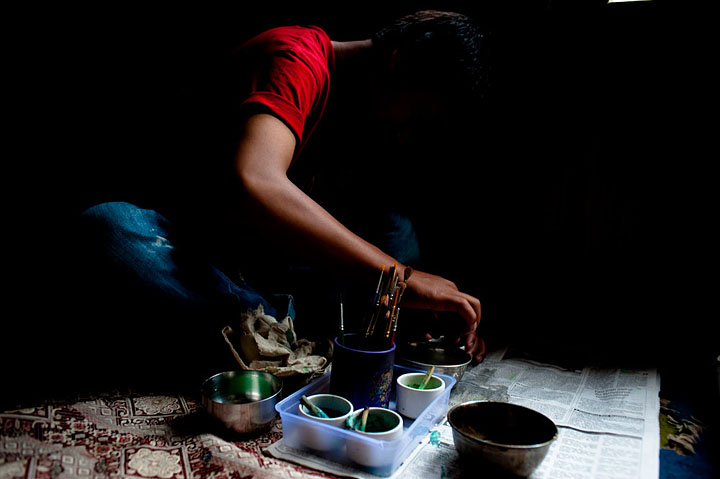

Photo © Mohit Gupta-All Rights Reserved

Thankas
by Mohit Gupta

Originally hailing from Himachal Pradesh, Mohit Gupta is an independent photographer based in New Delhi, who specializes in travel and documentary photography. He received his tertiary education in one of India’s most prestigious engineering schools – BITS, Pilani, and upon completing his studies in Computer Science in 2001, he joined Adobe Systems. It's a no brainer as who was the man to go to when anyone in our class needed technical assistance!

For Mohit, photography is a serious medium for expression. A self taught photographer, he is mainly interested in documenting culture, traditions, rituals and religion, and has traveled within South East Asia to do just that. He also works with NGOs and helps them documenting their work.

A perfectionist with a keen visual eye for colors and shadows, Mohit spent a number of days improving his presentation. Not easily satisfied, he was constantly refining his audio recordings until he got what he wanted, and then spent hours sync'ing it as precisely as humanly possible.

As I said in my opening remarks at the Foundry Workshop, I learned from the class participants much more than they did from me. I hope it's obvious why.

Ajit Patel: Indian Colors


Based in Mumbai, Ajit Patel is an award-winning freelance advertising photographer, with the background of having produced documentary movies in London.

His website reflects his initial passion for black & white, but that has evolved to color. His favorite camera is the Hassleblad X-Pan because, as he puts it, he enjoys the space it provides in composing visual elements.

There are a number of galleries which demonstrate Ajit's careful composition and love of colors. For instance, his photographs in the Indian Colors gallery underscore these very talents. And perhaps influenced by Degas, Ajit shows us a lovely subdued mood in his gallery titled Ballet School.

A versatile photographer, Ajit's galleries is certainly worth your time...I only wish his photographs were shown in a larger size to appreciate them better.

Thứ Ba, 15 tháng 2, 2011

Poras Chaudhary: Colors of India


Poras Chaudhary is a freelance photojournalist and a documentary photographer, who started photography in earnest in 2005. Influenced by the work of various Magnum photographers, he is self-taught photographer and prefers highly saturated color work.

He won a number of awards including the Digital Camera Magazine’s ‘Photographer of the Year’ award in 2006, National Geographic Traveler’s photo contest Merit Award winner in 2008 as well as being a Runner Up in ‘Epson Color Imaging Contest 2008’.

While the above image is of Poras' gallery "Festival of Colors", I'd suggest you also navigate to his Ladakh gallery, where you'll see one of the best photographs of his collection; the three Bakarwal shepherds.

Holi, also called the Festival of Colors, is a popular Hindu spring festival observed in India, Nepal,Bangladesh, and countries with large Hindu diaspora, and is said to have a medicinal reasons. The spring season is believed to cause viral fever and cold, and the colored powders used during the festival are made of Ayurvedic medicinal herbs.

Perhaps we should try this out to combat H1N1 flu infections?

"posted by TTP robot"

Thứ Bảy, 12 tháng 2, 2011

Palani Mohan: VIVID


Here's VIVID, a blast of colors that will surely jolt your senses into overdrive! It's a collection of "color-caffeinated" photographs by Palani Mohan of various (mostly of the Indian Holi festival) scenes of tremendous color.

Palani was born in Chennai, India, and moved to Australia as a child. His photographic career started at the Sydney Morning Herald newspaper, and since then he has been based in London, Hong Kong, Bangkok, and now Kuala Lumpur. Malaysia.

His work has been published by many of the world's leading magazines and newspapers including National Geographic, Stern, Time, Newsweek, and The New York Times. He also published three photographic books. Palani's work has been recognized with awards from World Press Photo, Picture of the Year, National Press Photographers Association, American Photo and Communication Arts. He is represented by Getty Images' Reportage Group in New York.

The Travel Photographer blog previously featured Palani Mohan's work here.

Thứ Năm, 10 tháng 2, 2011

Carsten Bockermann: India's Ambassador


I expect that the seasoned India travelers bemoan the slow reduction of the beloved Ambassador cars on the country's roads. It's manufactured by Hindustan Motors and in production since 1957. It's based on the Morris Oxford III model first made by the Morris Motor Company in the United Kingdom from 1956 to 1959.

I recall my first road trips in India were in a pristine (and many times, in less so) white Ambassador, with its seats covered with white cotton sheets and a wheezing air-conditioning that spewed tepid breeze, if at all. The drivers were frequently dressed in starched white shirts and white trousers. These days, the vehicles that drive me about are Japanese models, bland and bearing weird model names.

No doubt Carsten Bockermann felt the same way, since he now produced an ode to the Ambassador in his Moving India; a slideshow documenting the Ambassador's assembly line at the Hindustan Motors factory at Uttarpara in the state of West Bengal.

Carsten Bockermann is a German photographer who specializes in photographing everyday life in different cultures around the world using a combination of direct reportage and visually interpretative style. His work appeared on The Travel Photographer blog here.

Niki Taxidis: Nepal & Tibet


Here's the work of Niki Taxidis, an Australian-born freelance photographer who worked in remote areas of Australia in health care and forensic sciences for over 12 years. She spent two years as a crime-scene examiner and photographer and has volunteered in health care, education and photographic projects both overseas and within Australia.

Don't skip the entry page of her website, which opens up with a lovely piece of Tibetan music.

Thứ Bảy, 5 tháng 2, 2011

Alessandro Vincenzi: Mumbai Monsoon


Photograph © Alessandro Vincenzi-All Rights Reserved

Alessandro Vincenzi is an Italian photographer living in Madrid. A trained biologist, he joined Medecins Sans Frontieres and traveled the world with the humanitarian organizatio.

He has added new galleries to his website; one on transgenders and the other on the monsoon in Mumbai. The latter is classic street photography, and many of the gallery's photographs are full of humor, and 'decisive moments'.

Alessandro Vincenzi

Thứ Bảy, 15 tháng 1, 2011

Sandra Chandler: Moroccan Impressions


Following her return from our Gnawa Photo Expedition in late June, whose principal objective was to photograph the legendary Gnawa musicians during the 12th Essaouira Music Festival, Sandra immersed herself in working on her Moroccan Impressions, a collection of photographs that are to be shown at Tufenkian on September 3, 2009.

The venue's address is:

Tufenkian Artisan Carpets
515 NW 10th Avenue (in the Pearl District)
Portland, Oregon
503.222.3428 Ext: 105

Sandra is a photographer and interior designer based in San Francisco. She tells us that color, smells and sounds drew her to world travel. Her city's Asian culture first enticed her to China in 1978 when the People’s Republic first opened. She then continued her exploration of Asia by traveling to Bhutan, India, Japan, Singapore, Nepal, Thailand, Tibet, and on to South America and Europe. Her website is here (LINK).

The Travel Photographer blog had a previous post on Sandra here. (LINK)

Thứ Sáu, 14 tháng 1, 2011

8 Photographers : Access To Life


Photograph © Paolo Pellegrin-All Rights Reserved

The Global Fund is a unique global public-private partnership dedicated to attracting and disbursing additional resources to prevent and treat HIV/AIDS, tuberculosis, and malaria.

Here's a truly magnificent multimedia production for The Global Fund, and featuring work by Magnum Photos photographers such as Paolo Pellegrin, Alex Majoli, Larry Towell, Jim Goldberg, Gilles Peress, Jonas Bendiksen, Steve McCurry, and Eli Reed.

In Access to Life, these 8 Magnum photographers traveled to 9 countries, photographing people before and 4 months after they began antiretroviral treatment for AIDS.

This multimedia production must be one of the best I've seen, and ought to be studied by photographers wishing to learn about multimedia, and how to excel at producing them.

Thứ Năm, 13 tháng 1, 2011

Dede Pickering: World Photographer


Photo © Dede Pickering-All Rights Reserved

Dede Pickering retired from the corporate world and became a world traveler and photographer...it's just that simple and that complex. She has traveled to Antarctica, Mongolia, Tibet, Nepal, Bhutan, Burma, China, Cambodia, Peru, Patagonia, Kosovo, Albania, Rwanda, New Zealand, Guatemala, South East Asia and has made multiple trips to Africa and India, but her passion is the Himalayan Region.

Dede is involved with CARE, a global private humanitarian organization, and started the Women’s Initiative, aimed at connecting American women professionals with women in the developing world. She is also a member of the Explorers Club in New York.

Exploring her website with its remarkable photographs of different cultures, I stopped by her statement, of which this is excerpted:

"The lens of my camera allowed me to look inside the lives of others and blur the differences."
Dede's galleries are a delight for those of us who love travel photography at its best. You'll know what I mean when you do.

Thứ Năm, 6 tháng 1, 2011

Frederic Lemalet: Tibet

Photo © Frederic Lemalet-All Rights Reserved
Frederic Lemalet is a French travel photographer who, evidenced by his focus on Tibet, is in love with that region. He traveled to Alaska, Indonesia, Papua New Guinea, Russia, Mongolia, Kazakhstan, China, and Nepal...but it's Tibet that seduced him

Between 2003 and 2009, Frederic spent 3 years in Tibet, documenting its culture which may soon disappear. Distributing his time between his native France and Tibet, he's currently working on publishing books, and displaying his images in exhibitions. The last exhibition was "Himalaya" and held in Montier-en-Der (north-eastern France).

His Tibet gallery has 44 photographs, with a number of lovely portraits like the one I chose above...but don't miss those of the famous Tibetan wide open spaces, and of the Tibetan pilgrim praying in a sort of crude shelter made of stones. The photographs span the four seasons; a testament to Frederic's dedication to the region.